Showing posts with label USA. Show all posts

Friday, May 27, 2011

So Cal

Beachside breakfast in LA before hitting the road....


Southern California. Pausing only for a So Cal breakfast of yoghurt and organic fruit, and a manicure, I hit the road. The last leg of my road trip down Highway One took me from the delightful 'Shutters on the Beach' at Santa Monica down to Rancho Santa Fe, just north of San Diego. To tell the truth, I did abandon dear old Highway One for an excellent freeway that sent me breezing cheerfully into my friends’ house to stay a few days, with no more driving on the wrong side of the road for a while. I managed the LA freeways, but was glad to leave them behind.

Cafe culture

The beach at Del Mar

These few days featured some very tough things: fish meals on the beach, long walks on the sand, strawberries picked fresh from the fields, relentless sunshine...old friends and new. So hard to take. Not.
Impromptu dinner parties, champagne at a La Jolla art gallery, visiting some fabulous houses...getting used to the lifestyle of gated communities, five acre blocks of land, horseback riding and automatically hopping in the car to buzz down to the wine shop or the cafe or the bakery or the beach. Yoga in the mornings. Dinner table discussions of where to get the best organic produce and the benefits of wheatgrass shots. Hey, dude. This is SoCal.

Galleries in the afternoon...


Rancho Santa Fe is part of several estates of five-acre lots in the area. It is known for its many eucalyptus trees, planted by the Santa Fe railroad to provide railways ties - except that it was discovered that the wood was unsuitable, so various ‘ranches’ were established instead. Hollywood stars liked the place as a getaway – Douglas Fairbanks had a big ranch here.


The area is only about half an hour from San Diego proper, where there is lots to see. But I preferred to spend a lazy few days beachside, in my new ‘California office’! (Thanks, Brigitta and Michael).


Torrey Pines


Thursday, May 26, 2011

The dear old Queen....

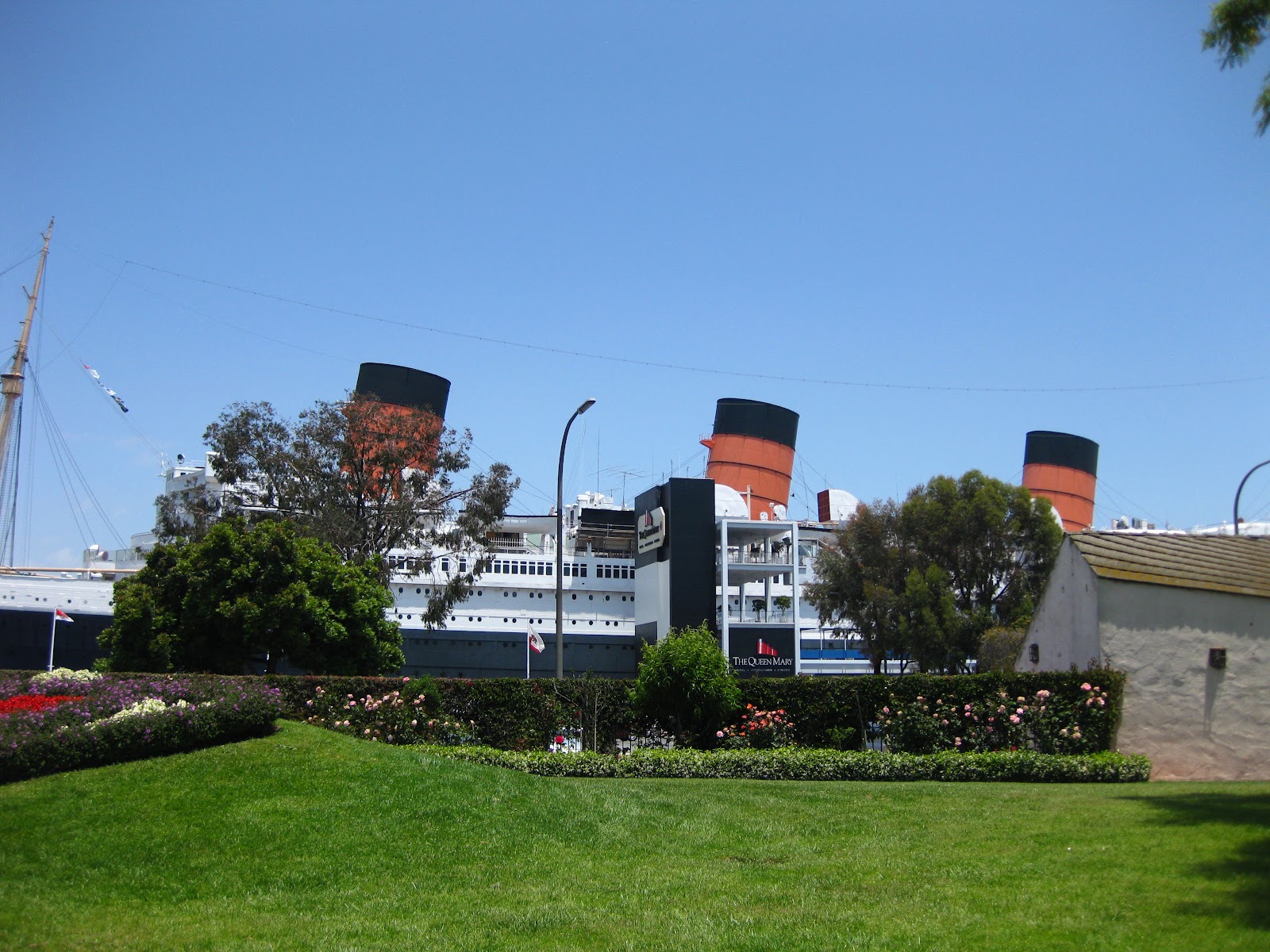
The three funnels of the 'Queen Mary'
No, not that one. The ‘Queen Mary’, steamship extraordinaire, currently resting in stately splendour at a dock in Long Beach, California. Today she’s a hotel and a tourist attraction, but her amazing past is a great story.

A magnificent lady
Launched 27th May 1936 – about a third as big again as the ‘Titanic’ and carrying around 2,500 well-heeled passengers back and forth across the Atlantic – within a few years she was dragooned into the War Effort as a troop ship. All her fabulous fittings, furniture, chandeliers and drapes were stripped out and put into storage at the Hudson River docks in New York, her Cunard Line colours were painted out with a dull grey, and she became ‘The Grey Ghost’, plying the five day Atlantic trip back and forth for the next seven years. 


Packed to the gunwales with troops
Her decks and staterooms and promenades were massed with squashed-in troops, 5,000, 8,000 – up to a maximum of over 16,000 on one voyage, which is still a maritime record. She was tailed by submarines and air force fighters, Hitler offered a reward for sinking her, but she was never hit, she could actually out-run the submarines, her life boats were never used, and the only damage she ever suffered was to her hull when one of her own escorts got too close (it was cut in two and The Queen powered on...it is a VERY bit vessel). With the war over and troop movements no longer needed, she continued to sail back and forth, bringing home war wounded and war brides.

The Promenade Deck
The only way to travel.
Then it was back into the role for which she was intended: a floating palace for the great and good to travel back and forth between New York and Europe. In the old days, the First Class fare was the equivalent of $75,000 today; Hollywood elite, industrialists and philanthropists, statesmen (Churchill was on her three times) and minor royalty (think Edward VIII and Wallis Simpson) considered the ‘Queen Mary’ the only way to travel. Her saloons and ballrooms are lined with wood from all the colonies of England (there are fewer colonies now, and some of the woods are extinct); her fixtures are brass and etched glass, Art Deco splendour. Bing could be at the piano as we speak (he gets around – you may recall that we met him back at Hearst Castle a few days ago). Her last crossing as a passenger liner was in 1967.

'Greg'
On my visit to the ‘Queen Mary’ I joined a tour led by a great raconteur (possibly a ‘resting’ actor) named Greg, who wore a maritime uniform, stood on the staircases, and declaimed various speeches in the persona of the Captain or Winston Churchill. I love LA. The ‘Queen Mary’ had a sister ship, the ‘Queen Elizabeth’ which is with us no longer – Cunard ran a two-ship weekly service across the Atlantic; and we can only be grateful to the City of Long Beach for purchasing the old Queen and keeping her in repair and accessible. But I must confess to a tiny disappointment that she needs to have so many of her salons turned into souvenir outlets and fast-food restaurants; and that he elegant promenade deck needs quite so many ATMs and smoothie bars. Then there is the tacky ‘ghost tour’...which I took anyway, because excitingly you get to go down into the First Class swimming pool area (inside the bowels of the ship), and into the boiler rooms (the boilers – she was a steam ship, remember) have been removed), and right into the bow where she hit that unfortunate escort ship, all of which is very exciting. You just have to ignore the silly commentary, loud noises and unnecessary darkness.

I couldn’t help but feel that it would be a delight to see the old Queen restored to the splendid days, with all her spaces having their original functions. That ‘wedding chapel’ could be turned back into the First Class smoking room; that place selling t-shirts could be the Ballroom lounge again.

The Verandah Grill on the sundeck.
All you need is the G&T


I wasn’t able to check out the experience of staying on the ship in her hotel accommodations – perhaps that’s an adventure for another day. And there’s the restaurant on the sundeck, the Verandah Grill, which was so popular in its heyday that even the First Class passengers had to book a table two months before they sailed and pay an extra $3.60 (presumably a lot in 1935)...I hope the cuisine there today lives up to the glory days. According to Wikipedia it has been a struggle to keep the ship open at Long Beach, with bankruptcy looming at times. I can only recommend that you go see her while she’s still with us, because she is a wonderful and amazing ship.


The ‘Queen Mary’ s stats:
Type:
Ocean liner
Displacement:
81,961 tonnes
Length:
1,019.4 ft (310.7 m) oa
965 ft (294.1 m) B.P.
Beam:
118 ft (36.0 m)
Height:
181 ft (55.2 m)
Draft:
39 ft (11.9 m)
Propulsion:
24 Yarrow boilers , 4 sets of Parsons single-reduction geared steam turbines on 4 shafts, 160.000 shp
Speed:
approximately 28.5 kn (52.8 km/h; 32.8 mph) service speed.
Capacity:
2139 passengers: 776 first (cabin) class, 784 tourist class, 579 third class
Crew:
1101 crew

She’s impressive. A modern day cruise liner was moored nearby when I visited. Our guide Greg looked over at it and remarked. “and they call that a ship...”


But she came through unscathed.....


Wednesday, May 25, 2011

The Getty Legacy


 John Paul Getty was a wealthy – very wealthy – American industrialist. He was also a great collector of art and antiquities, with a deep interest in ancient times. He had a ranch in Malibu, perched up in a canyon looking down on what is now the Pacific Coast Highway. His collection grew so large that in 1954 he turned his ranch into a kind of house museum. The bright and beautiful of Los Angeles would put on their furs and trilbies and come to view the treasures, three afternoons a week, before cocktails.

The Outer Peristyle gardens at the Getty Villa
Then Mr Getty found that his collecting was getting out of hand, so he decided to build a special museum for his stuff. Like a true dilettante, he aimed to re-create the Villa de Papiri. Now, if you have been reading this blog closely – and of course you have! – you may recall mention of the Villa de Papiri (House of Papyrus) in this entry on the Naples Museum. This Villa, near Herculaneum, has only partly been excavated from under the lava spewed upon it by Vesuvius. But just in case you were wondering what it (or any typical Roman 1st century AD country villa) might have looked like, you need wonder no longer. You can go see it at the Getty Villa in Malibu!

Modern Roman?
I’m a bit ambivalent about this project. At first I thought it would be very exciting to see the re-creation. After stomping around a lot of ruins (as I have recently) I thought it would be particularly intriguing to see such a villa adorned with paintings and frescos, its columns unchipped and its roof intact. But having visited Getty Villa, I’m afraid it is not quite the success that its owner would have wanted (Mr Getty didn’t live to see the Villa completed – it was finished in 1974 and he died in 1973). I can’t quite put my finger on it, but I think it is the use of so many modern materials, the over-use of trompe d’oeil, the roofing-in of the atrium that would have been open in a Roman villa...Still, whether the re-creation (renovated in 2006) works or not, it is a very apt building for displaying the very good collection of antiquities. Of course, the collection is not anything like the scale and depth of the treasure houses of those crumbling edifices, the archaeological museums of Athens and Naples, but for a private collection amassed outside of Europe in the 20th century, it is pretty amazing.


The kouros - late archaic Greek?


The highlights are said to be the Hercules and the Kouros. Now, the Hercules is good – but I’ve recently been to the Vatican and the Palacio Farnese and Naples, and, well....The Kouros is a lot more interesting, because no one knows if it is a fake or not. This is discussed quite candidly on the audio guide, and it is most interesting to closely examine the statue (of a young man) with a view to deciding for yourself if it was carved by hand 2000 years ago, or whipped up in an Italian garage with power tools ten years ago. And they paid $7 million for it in 1985.


Is it real or fake....?
What do you think...?


But wait...there’s more, much more. The Getty Villa houses ‘only’ the antiquities from Mr Getty’s collection (of 44,000 – 1,200 on display). He was a very avid bower bird and the Getty Foundation has had to build an entire new building – actually a massive campus of buildings – to house the still-growing collection. Ten miles away, up on a hill above Pacific Palisades, sits the new Getty Center, worth visiting for the spectacular architecture as much as for the collection. 

The Getty Center

Approaching the Center

The architect is Richard Meier; the construction took nearly as long and was almost as over-budget at the Sydney Opera House – it finally opened in 1997 at a cost of $1.3 billion. The campus includes buildings housing the operations of the Getty Trust, as well as several galleries displaying European paintings, sculpture, furniture, photographs and temporary exhibitions. The gardens are a work of art in themselves (literally: the Central Garden is by artist Robert Irwin and is considered part of the Museum’s collection!) The whole thing sits beautifully on top of a ridge overlooking Los Angeles, and visitors approach on a little tram, after parking their cars at the bottom of the hill. I spent quite some time walking and sitting about absorbing the architecture and the views; but then...onwards– into the galleries.


The Robert Irwin Garden

The views of LA
Ah, yes! There's art as well...

With limited time and no desire to endure ‘museum overwhelm’, I chose my targets: Van Gogh’s “Irises”, Monet’s “Haystacks in Snow” and one of his 30 “Rouen Cathedral”s; a lovely display of Canaletto and his nephew Belotto and others who painted scenes of Venetian canals for English tourists to take home as souvenirs. Some nice Goya and Gainsborough and John Singer Sargent portraits. Very nice indeed. Of course I missed a lot – but it is always good to have a reason to return.


Meanwhile, the Getty Trust continues to expand the collection, run a conservation masters program, provide extensive educational facilities, and grants for art preservation projects all over the world. As far as I can make out, all of this is done on the proceeds of Mr Getty’s personal estate. No one charged me anything to see these collections and buildings (if you don’t count the parking fee – but hey!), and Wikipedia has some gossip about financial woes at the Trust in recent years; but it is undeniable that this legacy of one individual art-lover, J Paul Getty, is an extraordinary thing.


Tuesday, May 24, 2011

Hearst Castle

Hearst Castle

That's just a guest house
To visit Hearst Castle, you drive down the coast from Big Sur to San Simeon. At least, you do if the road is open. If it is closed by a rock slide, you drive back to Carmel (a great drive, I must say), across to Salinas (where John Steinbeck was born, so that’s interesting), then down 101 (boring but fast), back west across 49 (wine country, but you probably won’t have time to stop); then north again on Highway 1. *Whew* If, like me, you have a 2 pm booking for the Castle (tours must be booked), and you lingered too long over breakfast outdoors at the delightful Ventana Inn in Big Sur, you will be tired of driving and relieved to have made it in time for the tour, with about 30 seconds to spare.

Now, as to this Castle – you may be wondering. Is it a Castle? No, it’s a country villa (or ‘ranch’, as he called it) built by William Randolph Hearst, the newspaper and mining billionaire in the 1920s, 30s and 40s. It took him and his architect, Julia Morgan, 28 years to build the thing. It is said that Mr. Hearst (as he is always referred to at The Castle) changed his mind a lot. The general inspiration for the thing was a Spanish medieval cathedral, and that’s just what it looks like. Mr Hearst was fond of collecting, and he collected things like whole monasteries, massive stone fireplaces, convent doors, ancient Egyptian statuary...you get the drift? Hearst Castle is one of those things you should see if you are amazed by what man can produce – it’s in a similar category to, say, Venice or Disneyland.

Spanish church - told you....


The columns on the pavilion are 3rd Century - eek!
It also has the allure of the glamour years of Hollywood: the starlets and the leading men from Burbank and Hollywood would congregate here for country weekends. Mr Hearst built four special guest houses on the estate to accommodate them all. His ‘special friend’ (scandal!) was Miss Marion Davies, a 19 year old starlet when she met him, several decades her senior and married with a wife and five sons in New York to boot. All the great and glamorous gathered at Hearst Castle, and lolled around the pool, played tennis, drank martinis, smoked a lot of cigarettes and dressed for dinner. Winston Churchill stayed here; media barons and industrialists chewed on cigars while Bing Crosby played the piano. You get the idea.

Shall we dress?


It's as if Winston just left the room for a moment....
And what does it look like? Some bits are successfully beautiful; others step over that very fine line into kitsch and absurdity. The hilltop terraces with sweeping views (Hearst owned all the land you can see from up here – inherited from his father who bought it cheap during the gold rush years), the rather spectacular outdoor swimming pool, the overdone but magnificently proportioned drawing room – these worked for me. The facade that looks like a catholic church started to worry me; the dining room is ridiculous: carved choir stalls along the walls, a long refectory table set with six places and some ketchup in the middle, disparate objets like a silver mace and flags from the Sienna horse races – nope, the dining room crossed the line into rampant acquisitive tastelessness.

Ridiculous, now

My gawd.
The movie theatre was acceptable – at least it was true to its era, and we got to watch grainy black and white film of Charlie Chaplin hamming it up around the Castle. And the final piece de rĂ©sistance was worth the price of admission – the indoor Roman Pool, with its exquisite reflections, gold leaf, marble ladders and copies of Roman tiles.


I left the bus, somewhat ambivalent about the whole thing, and headed to the fast food counter to munch on a beef sandwich – Hearst beef – the family trust still runs the property as a working beef farm. It is said that some zebra, descendants of Mr Hearst’s private zoo, still roam the property amongst the cattle. I kept an eye out, but can’t verify that story.


Sunday, May 22, 2011

If you go down in the woods today

Cruisin' to Big Sur (not my car *sadly*)


Monterey Bay
Heading out of Monterey I drove up Ocean View Avenue, passing some spectacular rocky sea scenery. Then I paid my $9.50, somewhat wryly, to drive the pithily named “17 mile drive”. This (admittedly well-kept) road hugs the coast and boasts more fine scenery on one side, and golf courses on the other. I stopped here to walk on the sand where some huge waves crashed – the sea seems to be boiling sometimes, due to undersea rocks – and to see the birds and sea lions. The road then winds through Carmel, or – to give it its full name – Carmel-by-the-Sea. More scenic splendour on one side, and on the other some wonderfully gimcrack-y houses with cutesy-tootsey shingle roofs. I paused at a wetlands, and on top of the hill at Carmel Mountain; then hit the really famous bit of road into Big Sur.

Highway One - Carmel to Big Sur

Your intrepid motoriste
Driving the coast road into Big Sur (and, I’m told, out of it) is nothing short of spectacular. The guide book is full of warnings about the perils of twists and turns and rockslides and other general perilousness, but I found that the biggest issue was the number of times I needed to pull over and stop to take in an amazing view or walk down to a strip of pristine beach with crashing waves, or to goggle at the road snaking away across a teetering narrow bridge over a gorge. The driving itself wasn’t too bad (the Amalfi Coast, with which this stretch is often compared, seemed a little tougher driving to me). I don’t think I’ve ever been on a road with more pull-outs for stops – or more cars taking advantage of them. I took about 2 hours to do a 45 minute drive, in a stop-start fashion.

I cruised across the famous Bixby Bridge, which spans Rainbow Canyon and is one of the world’s highest single-span bridges at 260 foot high. It was built in 1932 with prison labour (a prisoner could reduce his sentence by working on the bridge).  

Bixby Bridge and the fabulous coast


As I mentioned, the road is reputed to continue its spectacular way south of Big Sur, but I discovered that I, sadly, would not be going that way. A rock slide has taken out the road about 45 miles south, thus effectively cutting the only coastal link between here and points south. My route will be back the way I came....and inland, then north again. About 3.5 hours instead of 1.

But that is for tomorrow. Today, I lunch at Nepenthe, a hilltop terrace restaurant with spectacular views which is something of an icon in these parts. The name comes from Greek myth, and it has its modern myth too: Rita Hayworth and Orson Welles bought the place in 1944. Apart from the views, the attack raids by the blue jays on your food are also memorable.


Nepenthe: lunch with a view


Contemplating a little Henry Miller in the woods
As to Big Sur itself, blink and you’ll miss it. The population is said to be 1,000, though that may be stretching it. As my guide book (Lonely Planet) puts it: “Big Sur is more a state of mind than a place you can pinpoint on a map. It has no traffic lights, banks or strip malls, and when the sun goes down, the moon and stars are the only streetlights.” In the 1950s and 60s Big Sur was a retreat for the funky writers of the Beat generation, such as Jack Kerouac. Perhaps most notoriously, Henry Miller lived here for 17 years – after his Paris phase and Anais Nin and his books being banned in English-speaking countries and all that fuss. I visited the “Henry Miller Memorial Library” which sells his books and keeps the flame burning. Big Sur is said to still “attract mystics, artists, hippies and eccentrics looking to contemplate their navels, along with city slickers eager to unplug their iPhones...”

Actually, you don’t really need to unplug your iPhone because the reception is pretty dodgy anyway. But as compensation for the lack of connectivity, I did meet several wild deer on my way to dinner through the woods.

It would be appropriate to give you a few words from Henry Miller on the subject of his beloved home, Big Sur:

It was always a wild, rocky coast, desolate and forbidding to the man of the pavements, eloquent and enchanting to the Taliessins. The homesteader never failed to unearth fresh sorrows. There were always birds: the pirates and scavengers of the blue as well as the migratory variety. (At intervals the condor passed, huge as an ocean liner.) ...Though young, geologically speaking, the land has a hoary look. From the ocean depths there issued strange formations, contours unique and seductive. As if the Titans of the deep had laboured for aeons to shape and mould the earth. Even millennia ago the great land birds were startled by the abrupt aspect of these risen shapes. There are no ruins or relics to speak of. No history worth recounting. What was not speaks more eloquently than what was. Here the redwood made its last stand. (from ‘Big Sur and the Oranges of Hieronymus Bosch’)


Friday, May 20, 2011

Cannery Row


 Cannery Row in Monterey in California is a poem, a stink, a grating noise, a quality of light, a tone, a habit, a nostalgia, a dream. Cannery Row is the gathered and scattered, tin and iron and rust and splintered wood, chipped pavement and weedy lots and junk heaps, sardine canneries of corrugated iron, honky tonks, restaurants and whore houses, and little crowded groceries, and laboratories and flophouses. – John Steinbeck, 1945
Then.

Cannery Row in Monterey in California is a chi chi dress shop, a jazz bar at happy hour, a chocolate house, a fish restaurant, another fish restaurant, a souvenir outlet, an ice cream parlour. Cannery Row is the renovated canneries, the Monterey Aquarium, little crowded galleries, carefully tidied history and the forethought of the city fathers in 1958 who changed the name of the street from Ocean View Avenue to Cannery Row to tie it forever to Steinbeck’s novel. – Annette Freeman, 2011

Now.


Ready for both sea lion
and literary reference spotting
My hotel room in Monterey looked out over Monterey Bay and swimming in Monterey Bay was a cheerful sea lion, munching something he or she had found at the bottom of the Bay. The hotel had provided a pair of powerful binoculars so I could see the contented expression on the face of the sea lion. I also spent some time scanning the horizon for whales, said to be plentiful all year round along this bit of coast; but as so often with whale watching, the anticipation was all there was.

Here in Pacific Grove, just outside of Monterey city, the hotels and tourists have taken over where the sardines left off, as they so suddenly did in the 1950s, having been fished to extinction by unsustainable industry. Instead of docks and fishing boats and nets and canneries and processing plants, there followed desolation and unemployment; then clever real estate speculation and finally redevelopment. Overhead bridges used to cross Cannery Row from the sheds along the wharf to the processing plants on the other side of the street. There are three of four left (one at least I suspect is a reconstruction), keeping the distinctive touch of the old days. A handful of the old tiny fishermen’s cottages survive; and John Steinbeck (who was born in nearby Salinas and lived in Monterey for a while) gets a statue on one street corner.

Monterey Bay Aquarium

At the end of the Row stands the famous Monterey Bay Aquarium, with some excellent displays and a fervent message: sustainability. Cannery Row learnt that lesson the hard way. 

The kelp pool, washed with gallons of sea water every day, has a school of sardines, so the old days are invoked. The spotted jelly fish are amazing; the seahorses and Leafy Sea Dragons delightful; there are flamingoes (flamingoes?), turtles and penguins - rather stretching the 'Aquarium' description, but making for great displays. The Spotted Jellies were perhaps my favourite. I could have watched them all day.


A Leafy Sea Dragon.
Isnt' he (or she, or possibly both) delightful?


On my way south to Monterey, tooling along California’s scenic Highway One in my hire car with Roy Orbison turned up loud, I stopped for lunch at the boardwalk of Santa Cruz. Few signs are left of the Santa Cruz Boardwalk’s heyday of Bathing Beauty competitions and tea dances at Coconut Grove. Today the Boardwalk is still a well-patronised fun fair, but the rides are modern and safe and the food is of the hot dog and fries variety. I had my lunch on the Boardwalk. This may have been a mistake.