Showing posts with label History. Show all posts

Saturday, June 11, 2011

Benjamin Hyrons


Ben Hyrons' Cottage, George Town, Tasmania

Colonial Times, Friday February 27, 1827:
“Benjamin Hyrons, Boot and Shoemaker, begs leave to acquaint his friends and the public, that he has opened an establishment in Liverpool Street, directly opposite to Mr Molloy’s, where he will still continue to carry on the above business in all its branches; where he has also on sale, a variety of leather, either wholesale or retail, at the lowest prices, consisting of sole leather, kip ditto, kangaroo skins, and basil. A quantity of clean washed wool for sale.”

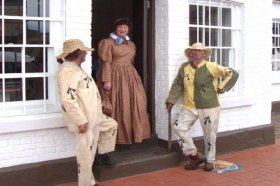
Hamming it up at The Old Watch House, George Town
Few convicts sent to the notorious Van Diemen’s Land made as much of their new life as did Ben Hyrons, transported in 1818 for passing counterfeit coins. The cottage he built in George Town, Tasmania, is my little haven in my home town - the oldest weatherboard structure still remaining in the town, dating back to the 1860s. Its old, creaking floorboards, the convict-brick fireplace and the “ghost in the attic” always make a stay at Ben Hyrons’ Cottage memorable. On my recent visit it was also a thrill to see the old garden cleared out of the weeds and trees that had almost taken over completely, revealing expanses of grass, a few fabulous old trees and lots of spaces for the bulbs and new plants to grow. A re-visit in the Spring seems a must.

Meanwhile, I also found that the local press “The Launceston Examiner” had recently published a supplement entitled “The Convicts of Van Diemen’s Land”, and amongst much interesting information about the days when ‘Tasmania’ was known as ‘Van Diemen’s Land’ was a biographical sketch of Ben Hyrons himself.

At the age of 20 Ben was sentenced to death for counterfeiting coins. He was born in Old Swinford, Worcester, England in 1795 and originally trained as a shoemaker. He married Amelia Baker in 1817 but just three weeks later they were both arrested for passing counterfeit currency. Ben escaped the gallows on a plea for mercy, but was transported for life to Van Diemen’s Land. Amelia was sent to New South Wales, and they were refused permission to reunite. Both ended up marrying other people. there’s probably an opera in that story somewhere.


Ben Hyrons arrived in Hobart Town in 1818 and worked as a shoemaker. He was given his ticket-of-leave (a free pass, as it were, for convicts of good behaviour who had served seven years) in 1826, and - as the newspaper advertisement quoted above shows - opened his own little business the next year. He married Sophia Wood in 1829 and began acquiring property in New Norfolk and Hobart. As many newspaper advertisements of the period attest, he became quite a busy businessman, acquiring many enterprises and getting caught up in legal battles with defaulting tenants and business associates.
Ben was 35 years old when he was granted a conditional pardon. 


Cosy Cottage
He moved north to Launceston and became a publican. This, one assumes, was a profitable business in a far-flung colony full of soldiers and ticket-of-leave men. Sophia died soon after the move to Launceston, leaving Ben with two children; but he shortly married again to Mahala Hedditch, and innkeeper’s daughter. In 1833 he moved back to Hobart and became a food and wine merchant in Liverpool Street; and later built the Commercial Inn in Murray Street. He seems to have thereafter concentrated on pubs, and owned The Rising Sun Hotel and London Wine Vault in the south, and the London Tavern in the north. In 1845, Ben’s Angel Inn in Charles Street in Launceston became one of the first buildings in the town to have gas lighting. 

In a factoid of which I was previously unaware, I learnt that Ben Hyrons also established the Royal Olympic Theatre in Launceston to host touring performing groups. The theatre is described as Launceston’s first.

Hobart, 1887
And then came the coach runs: Ben established his first coach service between Launceston and Hobart in 1840 and later won the mail contract. However, this was a tough run - what takes two hours to drive today took many hours through bushranger-infested rough country in 1840. Ben Hyrons’ coach services at one point travelled to all the major towns in the colony, and his inns supported the service as posting houses where the horses could be stabled and changed. At one stage he had inns at Longford, Cressy, George Town and Launceston. During the 1850s he bought steam boats to operate between George Town and Launceston.

In 1859 Ben and his wife settled in Launceston where they ran their new inn, known as the Three Grand Masters (I’m intrigued to know why); and around 1860 that built the house in George Town which remains as the town’s oldest weatherboard structure. 

Having finally brought Ben the George Town and the Cottage which bears his name, I must sadly advise that Mahala dies in 1861. However, after living for  a time at the Longford Hotel (I can’t resist listing every pub he was associated with!) Ben married for the fourth time, to Maria Duncan who was 20 years his junior. The moved back to the Three Grand Masters in Launceston, which was renamed the Shakespeare Hotel. 

At the grand old age of 72, Ben Hyrons moved back to his cottage in George Town, where he died on January 21, 1873. Perhaps it was his ghost I heard walking upstairs int he wee small hours, both night that I slept there....


Family Tree and Historical information on Benjamin Hyrons
Coach services in early Tasmania


Thursday, May 26, 2011

The dear old Queen....

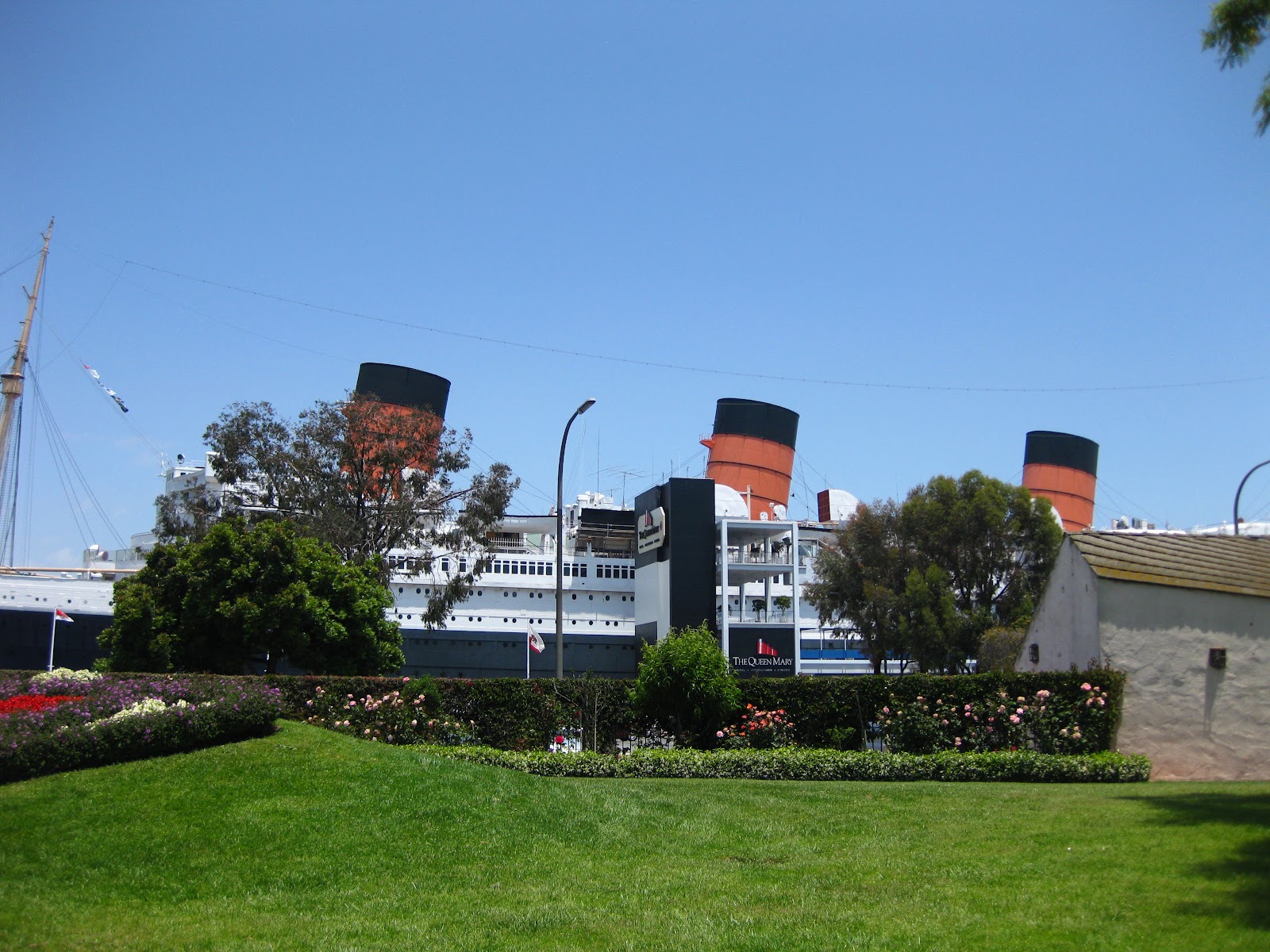
The three funnels of the 'Queen Mary'
No, not that one. The ‘Queen Mary’, steamship extraordinaire, currently resting in stately splendour at a dock in Long Beach, California. Today she’s a hotel and a tourist attraction, but her amazing past is a great story.

A magnificent lady
Launched 27th May 1936 – about a third as big again as the ‘Titanic’ and carrying around 2,500 well-heeled passengers back and forth across the Atlantic – within a few years she was dragooned into the War Effort as a troop ship. All her fabulous fittings, furniture, chandeliers and drapes were stripped out and put into storage at the Hudson River docks in New York, her Cunard Line colours were painted out with a dull grey, and she became ‘The Grey Ghost’, plying the five day Atlantic trip back and forth for the next seven years. 


Packed to the gunwales with troops
Her decks and staterooms and promenades were massed with squashed-in troops, 5,000, 8,000 – up to a maximum of over 16,000 on one voyage, which is still a maritime record. She was tailed by submarines and air force fighters, Hitler offered a reward for sinking her, but she was never hit, she could actually out-run the submarines, her life boats were never used, and the only damage she ever suffered was to her hull when one of her own escorts got too close (it was cut in two and The Queen powered on...it is a VERY bit vessel). With the war over and troop movements no longer needed, she continued to sail back and forth, bringing home war wounded and war brides.

The Promenade Deck
The only way to travel.
Then it was back into the role for which she was intended: a floating palace for the great and good to travel back and forth between New York and Europe. In the old days, the First Class fare was the equivalent of $75,000 today; Hollywood elite, industrialists and philanthropists, statesmen (Churchill was on her three times) and minor royalty (think Edward VIII and Wallis Simpson) considered the ‘Queen Mary’ the only way to travel. Her saloons and ballrooms are lined with wood from all the colonies of England (there are fewer colonies now, and some of the woods are extinct); her fixtures are brass and etched glass, Art Deco splendour. Bing could be at the piano as we speak (he gets around – you may recall that we met him back at Hearst Castle a few days ago). Her last crossing as a passenger liner was in 1967.

'Greg'
On my visit to the ‘Queen Mary’ I joined a tour led by a great raconteur (possibly a ‘resting’ actor) named Greg, who wore a maritime uniform, stood on the staircases, and declaimed various speeches in the persona of the Captain or Winston Churchill. I love LA. The ‘Queen Mary’ had a sister ship, the ‘Queen Elizabeth’ which is with us no longer – Cunard ran a two-ship weekly service across the Atlantic; and we can only be grateful to the City of Long Beach for purchasing the old Queen and keeping her in repair and accessible. But I must confess to a tiny disappointment that she needs to have so many of her salons turned into souvenir outlets and fast-food restaurants; and that he elegant promenade deck needs quite so many ATMs and smoothie bars. Then there is the tacky ‘ghost tour’...which I took anyway, because excitingly you get to go down into the First Class swimming pool area (inside the bowels of the ship), and into the boiler rooms (the boilers – she was a steam ship, remember) have been removed), and right into the bow where she hit that unfortunate escort ship, all of which is very exciting. You just have to ignore the silly commentary, loud noises and unnecessary darkness.

I couldn’t help but feel that it would be a delight to see the old Queen restored to the splendid days, with all her spaces having their original functions. That ‘wedding chapel’ could be turned back into the First Class smoking room; that place selling t-shirts could be the Ballroom lounge again.

The Verandah Grill on the sundeck.
All you need is the G&T


I wasn’t able to check out the experience of staying on the ship in her hotel accommodations – perhaps that’s an adventure for another day. And there’s the restaurant on the sundeck, the Verandah Grill, which was so popular in its heyday that even the First Class passengers had to book a table two months before they sailed and pay an extra $3.60 (presumably a lot in 1935)...I hope the cuisine there today lives up to the glory days. According to Wikipedia it has been a struggle to keep the ship open at Long Beach, with bankruptcy looming at times. I can only recommend that you go see her while she’s still with us, because she is a wonderful and amazing ship.


The ‘Queen Mary’ s stats:
Type:
Ocean liner
Displacement:
81,961 tonnes
Length:
1,019.4 ft (310.7 m) oa
965 ft (294.1 m) B.P.
Beam:
118 ft (36.0 m)
Height:
181 ft (55.2 m)
Draft:
39 ft (11.9 m)
Propulsion:
24 Yarrow boilers , 4 sets of Parsons single-reduction geared steam turbines on 4 shafts, 160.000 shp
Speed:
approximately 28.5 kn (52.8 km/h; 32.8 mph) service speed.
Capacity:
2139 passengers: 776 first (cabin) class, 784 tourist class, 579 third class
Crew:
1101 crew

She’s impressive. A modern day cruise liner was moored nearby when I visited. Our guide Greg looked over at it and remarked. “and they call that a ship...”


But she came through unscathed.....


Friday, May 6, 2011

Palermo

Where am I?
Mosaics in Cappella Palantina

Name the capital city of Sicily. Yes, it’s Palermo. How did you know? And it is a beautifully situated capital city too, strung around a handsome horse-shoe harbour, with steep attractive mountainsides behind. The city centre divides into the centro storico and the attractive 19th century streets that sprang up after Garibaldi rode into town and liberated everyone. It has two theatres, nice shopping streets, lots of characterful little trattatorias, a big cathedral, remnants of Norman city walls, and Sicily’s parliament. It also has THE most amazing collection of mosaics this side of Ravenna – some say that Palermo’s mosaics rival the famous ones of Ravenna. I’ll need to go to Ravenna to check this claim, I can see that.
Cappella Palantina: a riot of medieval colour
Sicily's Parliament Chamber

Marcella the guide is a local Palermo girl, and knew how to zero in on the best of the mosaics around town. The “must see” ones are in the Cappella Palatina, where you can also visit the (ex) Royal Apartments and the assembly room of the Sicilian government; and in Monreale, a separate town about 20 minutes drive up the hillside behind Palermo. In Monreale there is a magnificent cathedral and a Benedictine Abbey with a lovely cloister. The Monreale Cathedral was built by a Norman ruler of Sicily named William II, specifically to outshine the Cappella Palatina, which was built by his grandfather Roger II (Ruggerio II).


The cloister at Monreale

Monreale mosaics telling the Testament stories


Monreale. The Christ's hands are 7 metres apart.


Poolside at the Villa Igiea, Palermo

Villa Igiea. View from the room.
But you are sick of churches and monuments and ruins, you say? Then let’s go back to the divine Villa Igiea, which was originally built as a summer home for one of Sicily’s richest families (best not to ask), especially for one of the daughters of the family who was consumptive. The building later became a sanatorium, and is very pleasantly situated in lovely gardens on the bay. The decor is Art Deco and the rooms have tall windows that you can throw open to the sea breezes. On Easter Sunday there was live piano music, a special Easter Lunch menu, sunshine, and dining al fresco. Then there was the pool. Palermo’s climate is sub-tropical – the bougainvillea, hibiscus and frangipani were just beginning to flower. Was there something more you wanted?


Easter dolce
Easter Sunday Lunch

This completes my travel-related raves about Italy and Sicily – at least until I go back. Which seems inevitable.


Sunday, May 1, 2011

Tuna

Bonagia, Sicily


Tonnare de Bonagia: the buildings around the tower.
I didn’t actually appreciate that in Western Sicily I’d be staying in an old tuna fishery - but I told you Sicily was surprising. In a small (very small) place near Trapani, named Bonagia, there was once a traditional tuna fishing village called a tonnare. There used to be tonnares all along the coast here, where fishing families lived clustered around the sheds for processing tuna, rooms where the families lived, and of course a small chapel, making and mending nets and baskets. The tonnare in Bonagia has been turned into a hotel, with the buildings centred around a paved courtyard. The dining room and bar now occupy what was the tuna processing building. You sleep where the villagers used to live, and the chapel is still there. Outside the arched entrance with big old doors is...the sea. And the boats, and the current crop of local fishermen, who live in regular houses now, along the crescent of the small bay with its tangily-perfumed fringe of dried seaweed.

tuna with goat's cheese
Until not very long ago (and maybe still, though I didn’t hear anyone admit it) the tuna was fished here in the traditional manner, called the mattanza. The tuna were ‘herded’ between the mainland and a close-lying island, into a fixed net system, surrounded by the boats, and killed with spears and hauled out of the water by the brute strength of the fishermen alone. The sea became very bloody and the killing frenzy looks rather terrible (there is a gory wall painting in the breakfast room at the Tonnare de Bonagia). But in fact it is said to be a very selective method of fishing, resulting in sustainable stocks. Stories are told in Bonagia today of individual tuna weighing in at 700 kilos in the past, but now they reach only (a still respectable) 400 kilos. Dire mutterings are heard about the Japanese fishermen nabbing the best tuna on its migration from the Atlantic to the Mediterranean.

The tonnare is a nice place to stay, and the walls breathe a lot of history. The choice of what to have for dinner is also fairly clearly taken care of: tonno (tuna), of course. You might like to read about The Last Tonnara.

Canoli and coffee "Before"
If Trapani and its district are known for tuna, Marsala is known for...you guessed it, marsala. Large swathes of Western Sicily are covered in grape vines, where they’re not covered in olive trees, and the wine produced is gorgeously light and quaffable. The story of marsala, once the king of aperitifs in the 19th century, is rather patchy. Over-production and lack of attention to quality in the early twentieth century saw it relegated to cooking wine. But – and I knew you’d want me to check – I can report that the quality is back up where it should be, and this is a delicious aperitif style wine which goes excellently with Sicilian sweets. Nowhere near as sweet as a ‘sticky’ dessert wine. You can drink it with your 11 am canoli!

Canoli and marsala "After"

Ancient windmill. The green way.

Out on the roads between Trapani and Marsala is another ancient crop: salt. In the great salt pans of this area, salt is garnered from the sea by the age old method of evaporation. Sea water is let into large ‘pans’, becoming ever-shallower as the salinity increases, until once a year the natural sea salt is left, to be gathered (back-breakingly under the summer sun) and left to dry for six months under terracotta tiles. The pumping and grinding operations are powered by windmills – well, today there is some help from electricity, but you can see windmills silhouetted across the landscape. Originally they used nothing but wind power and an Archimedes’ Screw [see blog post on Siracusa!]. The salt was, and could still be, gathered with no modern fuel at all.


The salt pans of Nubia, near Trapani.
Erice: very nice once they let you in.
Bonagia, Marsala and Trapani are coastal towns – Trapani actually boasts a respectable sandy beach. But high on a beetling ridge behind them sits a tiny medieval town called Erice. It is said to have been settled by the Phoenicians around the 8th century BC, and to have housed the castles and garrisons of just about every occupier of Sicily ever since. But today the tourists have a bit more trouble getting in – operating in front of a bevy of ‘BENVENUTI A ERICE!’ signs is a ferocious lady parking officer, who will NOT let you park in a completely empty parking lot, on a holiday weekend, with car-sized painted parking spots, even if you buy a ticket. According to the uniformed señora, this is a parking lot for autobus only. So *** off.

Still, if you do manage to find a parking spot – it has to be on the edge of town, because Erice itself is a maze of narrow, cobbled streets, some barely wide enough for two people to walk – you will be delighted with the town. It has a rather lovely (reconstructed) Royal Church with beginnings going back to the 11th century. It has nuns in a cloister who bake and sell almond pastries. It has friendly locals who make great granita and will sell you some marsala. It has tiny pedestrian byways where you can walk completely alone (except for whoever is behind those ajar shutters up there). It has a castle and legends galore and views in all directions. There’s the Tonnare de Bonagia down by the sea, recognisable by its square Norman tower. Time to go home and eat more fish. Almond pastries and marsala for dessert.

Convent-made pastries

They have it all in Erice.

View from Erice to Bonagia and San Vito lo Capo
(that impressive cape in the distance). 


Wednesday, April 27, 2011

Sicily

Taormina


Regular blog readers may have noticed a slight hiatus in my up-until-now pretty excellent daily blog update record. This has of course been due to spending the last two weeks luxuriating in my wonderful holiday in wonderful Sicily. But now I’m ready to tell you more about this amazing island. Somewhere I read that the best description of Sicily is that it is constantly surprising, and this was certainly true for me. Food, scenery, people, traditions, food, stories, beaches, mountains, history, food...

Sicily - the red bit.
Sicily is the largest island in the Mediterranean. It is an autonomous region of Italy, and has been since unification in the 1860s – Garibaldi rode in with his ‘Thousand’ and liberated the island from the Bourbons in grand style, resulting in every town on the island having a ‘Via Garibaldi’. When I wanted to program the GPS in the hire car for a town centre and didn’t have a specific street address, I knew I could rely on getting to the centre of town by putting in ‘Via Garibaldi’. There are those, I’m told, who no longer revere Garibaldi (the old ‘sold-out-to-the-north' tune) but Garibaldi remains rather legendary anyway.

Taormina
Sicily has been occupied by foreigners for about 3000 years – possibly a world record – which some say accounts for the rise of that other well-known Sicilian institution, the Mafia. Whether or not this foreign interference accounts for the hunkering down of the rural community into self-protecting gangs, who knows; but today the only evidence I (knowingly) saw of the Mafiosi was a moving monument on the autostrada near Palermo’s airport commemorating the spot where the anti-mafia judge Giovanni Falcone was blown to bits in 1992. One month later, the judge who replaced him, Paolo Borsellino, was also blown up after visiting his mother. The airport is now named Falcone-Borsellino.

Sicily’s occupiers started with the Carthaginians in about the 8th century BC – Phoenicians from the Levant who had built the great city of Carthage in North Africa. They were followed by the Greeks, then some autonomous tyrants, the Romans of course, the Byzantine Christians, the Moors from Arabia for a few hundred years (fried food, sesame seeds, sweet-and-sour flavours); and then a succession of Europeans from Spain, England, and France....until Garibaldi and The Thousand appeared.

Taormina prepares for Palm Sunday.
And the topography? Very mountainous, lush agriculture, a wine industry that supplies a great percentage of the Italian wine production, a fishing industry which must surely do the same; plus honey and olives and salt retrieved from the sea by ancient evaporative methods; citrus everywhere; almond trees, olive trees...a cornucopia. In the past – the not very distant past – life was hard in small rural Sicilian towns, but at least they lived in paradise. In beautiful Palermo, the capital city, the climate becomes tropical in summer, and already the hibiscus, bougainvillea and frangipani are beginning to bloom.

Etna!!!!!
Cable car ascending Etna.
But Sicily is especially known for its volcanoes: Mt Etna (3,320 m) is the tallest active volcano in Europe and one of the most active in the world. It steams away on the horizon in north-eastern Sicily. In fact, there was an eruption about five days before I managed to travel up its slopes. The mountain was closed for the day: the eruption was described as ‘significant’ (rocks flung hundreds of metres into the air), but mercifully short (a few hours). So minor an incident for Etna, that it caused no real ripple nor news bulletins. The main issue which daunted my efforts to reach Etna was the foggy weather that shrouded the top of the mountain for a couple of days, but finally the clouds parted and I made a dash for it. Well, my guide and driver Carmelo made a dash for it...and then loaned me his jacket (“Its-a cold up there!”), put me on the chair lift and waved me off. The lift ascended through fog, arrived at a way station where jeep-style trucks were waiting; they ascended on a lava-grit road through ever-increasing snow drifts and more fog. Finally, spectacularly, we emerged above the fog and the steaming crater of Etna was revealed.

The fog rolls in again on Etna.
Off we tramped with a mountain guide, poked our noses into a smaller steaming vent – the guide assured us that this one would only send out steam now, no hot ash or lava – and climbed a ridge which was formed when Etna last really erupted, in 2001/02. The high point was 2, 950 m. On that occasion, several villages on the slopes of the mountain were damaged (I saw one Baroque church facade on the way up which was still propped up with girders and braces); and the roads and the tourist chair lift near the top had been destroyed. The ones we used were re-built since then. The snowy top of Etna, so close to the beach I had left that morning (only a 40 minute drive away), soon closed in with cloud again. I had been lucky to grab the opportunity.

Looking very pleased with self: on Mt Etna.
Guide Johanna and her red umbrella
In Taormina's Greek/Roman teatro.
Carmelo returned me to the hotel on the beach at Taormina, and I returned his jacket. Taormina is a town with a split personality: the main village is perched high on a rocky ridge, with the beach ‘burbs down below. A funicular (every 15 minutes) connects the two. I stayed in a hotel converted from a private villa, and funicular-ed up to see the village. Verdict? Picturesque, lovely shops and galleries, churches getting ready for the Palm Sunday service tomorrow, views to die for out across the coast. But Taormina’s big claim to fame is its unusual Greek theatre: the ruin is perched right atop the mountain. The Greeks didn’t use a backdrop for the stages of their theatres: the audience looking down at the players would have seen behind them an extraordinary view of the coast - and of Etna. The Romans, on the other hand, liked to erect ‘scenery’ – a back-drop to the stage, such as we use today and still call ‘scenery’. At Taormina, the Romans neither left the Greek theatre like it was (as in Siracusa) nor completely destroyed it. Instead, they built some obvious and interesting adaptations, including the aforementioned scenery (blocking the view somewhat), some porticoes entrances, some side dressing rooms, some pits for the animals they used, some extra seating. In the ruins today it is easy to see the hands of the Romans overlaying the hands of the Greeks. Molto interessante.

Back to the beach: Taormina
Ah, but that’s enough sightseeing – back to the Villa Sant’Andrea, some local fish courtesy of Vincenzo, the chef, perhaps preceded by a prosecco aperitif. Plenty of variety in Sicily.

Sicily: my route - Catania, Siracusa, Taormina,
Vulcano Is. (not on the map),
Trapani, Erice, Agrigento, Palermo.


Wednesday, April 20, 2011

Ah, Siracusa. Bellissimo!


Siracusa, Sicily

There is so much that is wonderful about Siracusa, on the south-eastern tip of Sicily, that I hardly know where to begin. One hour’s drive in the rental car south of the airport at Catania, and some rather rough small-town outskirts appear, soon to be replaced by some elegant looking facades and churches. Then soon, across a small bridge, is the island of Ortigia, and you are in Old Siracusa. You are far from the first visitor. Plato came here. More than once. It was colonised by Greeks from Corinth in the 8th century BC. It is not possible to do justice to Siracusa in one short blog post, but I will try to give you a taste with this list:

Piazza Duomo, Siracusa

a.       Archimedes was born here in 287 BC. The famous mathematician and scientist from ancient times probably actually took his famous bath here: you may recall that it was while Archimedes was soaking in his bath that he worked out the principle that ensured his fame: that a body immersed in liquid is subject to a force equal to the weight of the volume of the liquid that has been displaced. It is said that he was so thrilled with this discovery that he leapt from his bath shouting “‘Eureka!” Today one of Ortigia’s delightful squares is named Piazza Archimedes. I sat in this piazza for an evening aperitif, and saw a bride, in her white gown, waiting at a bus stop.

Piazza Archemides

b.      The Greek Teatro in Siracusa is one of the largest and best preserved to have survived from antiquity. It has about 49 ranks of stone seats still in place (carved directly out of the rock) but is thought to have originally had 69 tiers. This means it would have held about 19,000 people, which is more than double the size of most surviving Roman theatres. Several rulers of ancient Siracusa were keen on drama, poetry and the arts, and plays performed here would have been by such stars of the ancient world as Bacchylides, Xenophon, Simonides, Pindar and Aeschylus. The Hollywood of 300 BC.

Imagine the shows here...


The Ear of Dyonisius
c.       Orecchio di Dionisio (“Dionysius’ Ear”): a huge and haunting limestone quarry where slaves would have hacked out limestone blocks for building. Its entrance is shaped like a human ear, many metres high. Inside, the excellent acoustic accidentally produced enabled a passing guide to treat us to a haunting Sicilian love song (before the school children came hurtling down to try out their lungs). The cave was given its nickname by the renaissance painter Caravaggio in the early 1600s, when he heard about Dionysius (a tyrant ruler of Siracusa) being able to hear the approach of his enemies because of the echo in the cave. Caravaggio was on the run at the time, having killed someone in one of his frequent lively rages. To the benefit of Siracusa, he left behind a number of paintings commissioned during his stay, one of which I discovered in a church on the Piazza Duomo.


And speaking of the Duomo – this has to be perhaps the most extraordinary church I have ever visited (and as you know if you’ve been following, I’ve visited a few spectacular ones recently). The Ortigia Duomo is a Christian Catholic church built on and around a Greek temple. Now, often churches were built on the same sites as pagan temples, but in this case the columns of the temple were preserved and incorporated into the church. The effect is spellbinding: the great columns of the pagan temple have been enclosed and roofed, and the space they mark out is once again a sacred space. The effect is difficult to describe; but the church interior is medieval with a minimal number of Baroque flourishes, so the overall effect is beautiful and soothing. And there are those great columns, standing where there have stood for about 2,300 years, doing the same job that they were originally carved and erected to do.
Inside the Duomo...incorporating the pagan.

e.      But the Baroque and the medieval mix intriguingly in the backstreets of Ortigia.  Tiny narrow streets date from medieval times, when the island was held by the Arabs; and later through the Baroque period when ornate balconies were added to many windows, almost meeting the opposite houses.  The balconies of Siracusa are a study in themselves. Wandering the alleyways of the Arabs, of the Jews, of the medieval merchants, of the little trattatorias and the rustic restaurants where the smell of cooking fish wafts out...

f.        The small island of Ortigia, attached to the ‘mainland’ of Siracusa by two short bridges, sits in the surprising harbour of Siracusa: a natural harbour, almost circular, with a narrow opening which was easily defended; explaining why Siracusa is where it is. There is also a strange effect where an underground fresh water stream emerges to meet and mingle with the salt water of the harbour in an odd and sudden combination. In a legend of antiquity, one of the nymphs of the hunter goddess Artemis, tormented by a hunter, was turned into a stream so that she might escape underground and re-emerge on the island of Ortigia as a freshwater fountain. Today the fountain of Arethusa can be visited, filled with a few ducks and some clumps of papyrus. Papyrus is another surprising find in Siracusa: lovely handmade papers can still be purchased.

g.       And Plato? He travelled to Siracusa a couple of times, and attempted to convince the tyrants then ruling the city-state that they had a great opportunity to adopt his model for government, based on his ‘Republic’. This didn’t go down very well with Dionysius, neither the Elder nor the Younger, and both ended up expelling Plato home to Athens. It could have been that bit about the ideal Republic being ruled by philosopher-kings.

Earth mother: feeding twins.
h.      The Archaeological Museum: with such a treasure-trove of ancient sites in Siracusa, they need a good archaeological museum, and they certainly have one. Every bit of pottery ever dug up here and in the surrounding countryside, from Neolithic times onwards, has been dusted off, identified, labelled and displayed in the most comprehensive museum of its kind that I’ve ever come across; all housed in an excellent and well-kept purpose designed building. There is also a huge display of bronze pieces, weapons, jewellery, utensils, raw metal, found in a Bronze Age hoard, one of the largest of the “Sicilian Hoards”.

But if Neolithic pottery shards aren’t your thing (and you can have too much of a good thing), the Greeks, and particularly Roman, finds from the archaeological site help to bring to life what you see of the foundational remains. At the outdoor site, in addition to the Greek Teatro, there is also a Roman amphitheatre (gladiators, naval battles, wild animals, cruelty and spectacle); and a massive alter build by one of the Siracusa tyrants named Hieron II in the 3rd century BC, almost two kilometres long and big enough to slaughter and barbeque 460 bulls at once. As in many of these prosperous ancient cities, everybody’s villa and garden was decorated with statues and carvings and votive figures and fountains. Both the Greeks and then the Romans liked to surround themselves with art and beauty. Bits can be found preserved in the museum, some of them quite lovely.

Add to all these unusual and fascinating aspects of Siracusa an extremely lovely small hotel (Agila Ortigia), one of the best restaurants I’ve eaten at (”Don Camillo”), balmy evening walks around the harbour, Sicilian gelato, Sicilian Marsala, Sicilian fish, Sicilian oranges....remind me why I have to leave?

Siracusa harbour, sunset. *swoon*