Showing posts with label Opera. Show all posts

Sunday, May 15, 2011

Monty Python at the Opera

Mephistopheles tempts Faust

Monty Python’s Flying Circus meets Berlioz. What will happen? A gloriously busy, chaotic and evocative opera production with a charming Mephistopheles, that’s what. It wasn’t really Monty Python, but one of the members of the Flying Circus, Terry Gilliam, directing his first opera, Berlioz’s “The Damnation of Faust”. Berlioz’s opera was inspired by Goethe’s book “Faust” (Goethe twice in one week!) and first performed in 1854.

When Belioz wrote the piece he intended it as a concert performance, so when opera directors and designers get hold of it, things are known to go rather to their heads. I have seen it performed only once before, in a Robert Le Page production at The Met in New York, and the crazy video effects, acrobats, Susan Graham’s head projected over the whole of The Met’s substantial proscenium and a particularly amazing version of Faust and Meph’s crazy horse ride all remain memorable.

Faust tries to work out what life is all about.
At the English National Opera last week Terry Gilliam and his German designer Hildegard Bechtler gave us Faustian images from German Romanticism, through the WWI carve up of Europe by its crowned heads, to a Berlin weinkeller, to Auschwitz and war. The horse ride became a wild dash on a vintage motorcycle; the doomed Marguerite was doomed because she wore a yellow star. It sounds crazy, but it worked very well, with the copious stage business fitting the music and libretto (translated into English) more or less perfectly. Marguerite’s soul’s ascension into heaven was particularly poignant in its Auschwitz context.


Faust and Marguerite
Our Meph, Christopher Purves, was very well sung and played – but as someone reminded me, Meph is always charming. It’s part of his modus operandi. The tenor, Peter Hoare, did a good job with Faust and his bright red hair and the weight of the world on his shoulders; and Christine Rice sang Marguerite beautifully. I especially enjoyed the scene in her bedroom with Faust hiding behind her curtains – evocative, lovely singing, and a bit of respite from the lunatic craziness of some of the other scenes (which might have been a bit more overwhelming for me since my last minute ticket purchase meant I was sitting in the front row – a little further back may have been better).

Terry Gilliam has of course more to his credit than being the American member of Monty Python’s Flying Circus, including films and cartoons. I think his first opera excursion can be considered a success. 

Here's The Guardian's review. And The Telegraph's too.

And here's Susan Graham's Marguerite at the The NY Met in the Robert Le Page production.


Images from:

Monday, May 9, 2011

The Sorrows of Young Werther


In 1774 Goethe, the great German writer, dashed off a quick novella. It was in the style of the English gloomy novels of the time – things English were enjoying a bit of a fad on the continent at the time – and was entitled ‘The Sorrows of Young Werther’. Goethe’s novella was also cathartic – he had found himself in a bit of a three-some, doting on a young lady who was engaged to be married to someone else. He used that situation in his story, and ended it dramatically with his hero, Werther, committing suicide for the sake of love. Unexpectedly, the thing became an overnight sensation, becoming one of the best-selling novels of all time. All over Europe, men were dressing like Werther in the ‘English style’ (blue jackets, buff waistcoats, riding boots); and it was reported (though it’s possibly apocryphal) that young men across the country were emulating Werther and killing themselves, artfully of course, if they were unhappy in love. It is said that Napoleon read the book seven times.


Werther and Lotte
 Personally, once will be enough for me. But it is worth reading this short little story if only because it was so damn famous in its day. ‘The Sorrows of Young Werther’ is about bourgeoisie people, and it is about psychology, and on both counts it was unusual and way ahead of its time. Being written by Goethe, it also contains some well expressed insights here and there. But it is an over-blown and over the top Romantic-with-a-capital-R story. Sorrows, indeed. Poor Werther.

Fast-forward over 100 years to 1892 and the first performance of an opera based on Goethe’s novel, entitled simply ‘Werther’, with music by the French composer Massenet. Massenet’s music is sweeping, hallucinogenic and involving; and the music he writes for the character of Werther is some of the loveliest, anguished, tormented stuff you could possibly wish for. Of course, you need an exception tenor for the role...and the other night at Covent Garden the Mexican tenor Ronaldo Villazón gave us his all, and if at times we might have thought he was going to have a heart attack, we could only be humbly grateful. It was a performance to bring a tear to the eye, and I for one was blown away by Werther’s aria in the Third Act, 'Pourquoi me reveiller', which is the most beautiful thing. 


Last Act of the opera
Now, the internet is rife with gossip about Villazon and his voice, with many people accusing him of over-singing and ruining his voice. Here he is singing 'Pourquoi me reveiller' in 2009 - see what you think. I'm no voice expert, but when you get the audience at Covent Garden weeping into their hankies, and then responding to you with a massive ovation, I think you have probably done OK.


I must also mention the divine Sophie Koch, who was our Charlotte. A wonderful mezzo voice, whom I had heard before singing Strauss in Dresden. Her she is, singing the role in 2010, and the production is the same one as has opened at Covent Garden.


And finally, the ROH conducter Antonio Pappano and Ronaldo Villazón discussing the opera's opening at Covent Garden.


Images from:
http://www.matteomac.com/blog/2007/i-dolori-del-giovane-werther-j-w-goethe/I

Friday, April 29, 2011

Two brides today.


"Larry"
We interrupt the travelogue to report on the wedding fever which hit London today, Friday 29th April 2011. Yes folks, today the Royal Wedding sent Londoners into mad British holiday mode. The British appear to equate their Royals with serious patriotic fervour, and the town was painted red, white and blue. Now, I didn’t plan to take too much notice of it all, except for noting a photo of Larry, the Downing Street cat, posing in a Union Jack bow tie for the occasion, and the fact that Carluccio’s was completely empty this morning (except for me – the manager suggested I go home so that they could close). But then my baser instincts overcame me and I watched the proceedings on the internet. The sky was overcast but it didn’t rain, the bride wore her hair down, the dress was conservative, the ceremony traditional, there was no soloist (though the choir boys were lovely), and the fly-past by Blitz era fighters shook my windows. Harry didn’t drop the ring, the dear old Queen looked nice in yellow, no one made any interesting mistakes.

Oh, and the ration of utterly ridiculous hats reached what must be an historic high. An enjoyable day of ritual, pageant and a very chaste peck (or two) passing for a kiss on the balcony.

Hot off the presses: first pics

That completes my report of one Royal wedding. This evening I attended another, in a manner of speaking. Co-incidentally (because operas need a much longer lead time to organise than Royal weddings) Covent Garden tonight had scheduled “The Tsar’s Bride”, a Russian opera by Rimsky-Korsakov. It was a fitting way to spend the Wedding Afternoon and Evening, I thought.

Royal Wedding Street Party
First, I set out just after The Balcony Scene at Buckingham Palace, and made my way on the trains to Earlsfield, dodging Union Jack-draped monarchists wandering home from The Mall. In Earlsfield I was seeking the home of a couple of die-hard republican friends, and what should I find in their street but a genuine Royal wedding street party, complete with bunting and balloons. The republicans admitted to taking a peek at The Wedding on TV, and eventually they abandoned their principles sufficiently to spend the afternoon discussing the hats, the Dress, the Queen, the carriages, Diana, the horses and Prince Harry’s paternity. We ate roast lamb and toasted the happy couple with a nice Spanish Rioja.

Then off we set for the opera house, and were very pleasantly surprised with “The Tsar’s Bride”. Although popular in the Russian repertoire, the opera is rarely performed in Western Europe or the USA, and in fact this production is the first in any major English opera house. Now, if someone says that an opera is 3.5 hours long (with only one interval!), in Russian, dark and tragic, and nearly everyone dies, you don’t really expect to be in for a jolly evening. But in an inspired move, this production moved the action from the reign of Ivan The Terrible in the early 1500s to present-day Russia. The result was absorbing.

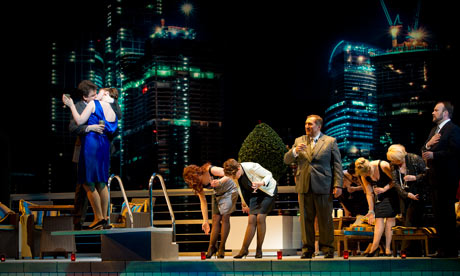
In the first act the scene was a cheap restaurant with vodka-drinking secret police, half-naked table-dancers and an impressive mink coat. Action moved to a derelict street corner, with girls in short skirts and mobile phones. After interval, the scene opened on a rooftop swimming pool terrace where an oligarch was throwing a party for tastelessly overdressed women; and the final scene was in the oligarch’s sumptuous reception rooms, where everyone was dressed for the wedding in – you guessed it – tails and hats. The cast was almost all...Russian.

The swimming pool scene.
Not wishing to stereotype, of course, but the theme here was about authority, power and money, historically and currently. Have you heard the one about two oligarchs who meet in the street? “How much did you pay for that tie?” “$500”, comes the reply. “You fool, I know a place where you could pay twice that!” They say there’s rich, there’s super-rich, and then there’s Russian rich. There are 25 billionaires in Moscow, as well as most of Russia’s 88,000 dollar millionaires.

But the story? I hear you ask. It is based on the true life story of Marfa Sobakin, the third wife of Ivan The Terrible, who died of suspected poisoning within days of her wedding to the Tsar. The opera opens with the Tsar choosing a new bride: 2000 girls have been gathered from across Russia for him to make his selection. If this were a Zefferelli production at The Met, we’d probably have had 2000 girls, but as it was we made do with somewhat fewer. The plot is complicated, but satisfyingly operatic, with secret police, a baddie who loves the heroine, an innocent tenor who is the childhood sweetheart of the heroine, a spurned mezzo, a love potion, a poison potion, and – naturally – a mix-up of the two. In the final scene, the colour scheme is heavily purple. You know what they say in show-biz: “If there’s purple, someone dies”. First the tenor is wrongly accused and executed, then the spurned mezzo is stabbed, then the baddie has his throat cut, then the Tsar’s poor bride wastes away. Here's a review.

The cast takes their curtain call.
I must say that the Buck House do was rather more cheerful. But at curtain call one of the cast unfurled a “William & Kate” Union Jack, to the delight of the audience – at least two of whom appeared to have come straight from Westminster Abbey, since they were wearing tails (him) and a substantial hat (her).

Just to finish off the day, the cab driver who drove me home told me that he had been a policeman at the time of Charles & Diana’s wedding, and had been on duty at The Mall the whole day. Everyone has a Royal wedding story in this town. This has been mine.

As waved tonight at the opera.

Images from: